The big shift: Enterprise orchestration
The dominant theme across ONE 2026 was a maturation in enterprise thinking about AI. The conversation has moved decisively beyond experimentation. According to OutSystems’ own research, 96% of organisations surveyed are already using AI agents in some capacity, and 97% are exploring system-wide agentic AI strategies.
But deploying agents reliably in real enterprise workflows – with auditability, predictable behaviour, and operational controls – is where most organisations are still finding their footing. ONE 2026 was squarely focused on solving that problem.
The conference reinforced three major trends shaping the enterprise AI landscape:
Agents need enterprise context to be trusted. The biggest barrier to agentic AI in production is not capability: it is context. Agents that operate without a full understanding of enterprise architecture, data semantics, security policies, and change history quickly become unpredictable and ungovernable. The direction is clear: agents must be grounded in enterprise reality.
Governance is the differentiator. Managing an AI portfolio across teams – who can build what, where agents can act, when humans must approve, and how outcomes are monitored – is becoming as strategically important as the AI capability itself.
Open ecosystems, centralised guardrails. Enterprises want the freedom to use different agentic tools and models without lock-in, but with a consistent, governed path to production. This tension between flexibility and control was a defining theme across the two days.
The standout announcements
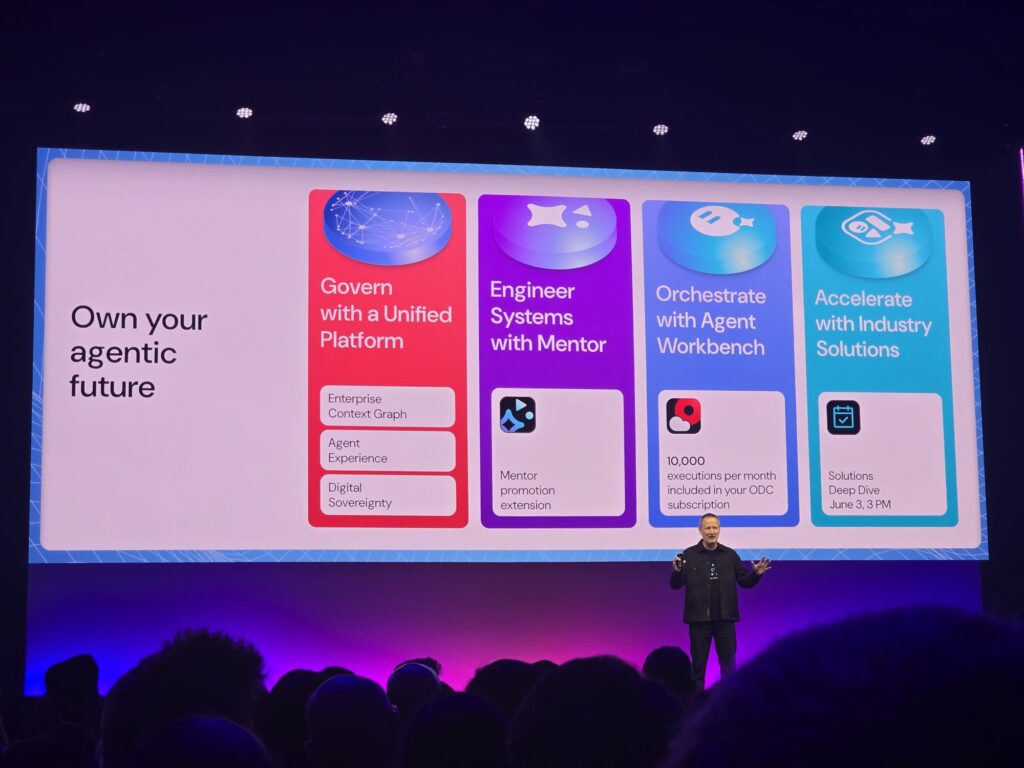
Agentic Systems Platform: The centrepiece announcement of ONE 2026. OutSystems launched its new Agentic Systems Platform, powered by the Enterprise Context Graph, a shared, real-time layer that gives AI agents a deep understanding of enterprise architecture, data, and policy constraints. The platform is designed to help organisations become AI-native while maintaining the governance, regulatory compliance, and operational control modern enterprises demand.
Agent Experience: A new platform layer providing enterprise developers with trusted tools to build, orchestrate, and govern their full agentic portfolio, including services for agentic coding, publishing, and platform extensibility, all went live at ONE.
Next-generation Mentor A significantly enhanced in-IDE experience delivering Agentic Systems Engineering directly within the platform – highly conversational, architecturally coherent, and built for the complexity of evolving enterprise systems at scale.
A landmark AWS collaboration: One of the most significant announcements at ONE 2026 was a major expansion of the OutSystems and AWS partnership, directly addressing three of the biggest barriers to enterprise AI success:
- AWS Transform for legacy modernisation: Agent-led code transformation that accelerates migration from legacy technologies, including COBOL and Lotus Notes, into modern, high-performance agentic systems.
- Native Kiro integration: Connecting spec-driven development with Mentor’s governed AI delivery, enabling teams to move from idea to production faster within a fully governed environment.
- Amazon Bedrock model hot swapping: Enabling enterprises to optimise for cost, performance, and flexibility by selecting the right AI model for the right task, without vendor lock-in.
"The shift toward agentic systems is the most significant architectural evolution of our lifetime. By collaborating with AWS, we are removing the friction between an organisation's legacy past and its agentic future. We aren't just helping customers build faster; we are providing the foundation to architect an entirely new generation of governed business systems."
Woodson Martin, OutSystems CEO
What ONE 2026 means for Australian and APAC enterprises
The announcements at ONE 2026 have direct implications for the organisations PhoenixDX works with across Australia and the Asia Pacific.
Legacy modernisation – already a significant area of PhoenixDX’s work – is now accelerating rapidly, with OutSystems and AWS providing automated migration pipelines that dramatically reduce the time, cost, and risk of moving from legacy platforms to modern agentic systems. For organisations still running COBOL, Lotus Notes, or other ageing infrastructure, the window to modernise has never been more accessible.
The Enterprise Context Graph and governed agentic architecture also validate the approach PhoenixDX has been championing with clients: that the path to enterprise AI is not about deploying the most capable agent, but the most trusted one – grounded in real architecture, real data, and real governance.
PhoenixDX returns from Amsterdam energised, informed, and ready to bring the best of ONE 2026 directly to its clients across the region.
Find out how PhoenixDX can help your organisation navigate the agentic AI era.
Book a meeting with us, and we will demo it for you.
