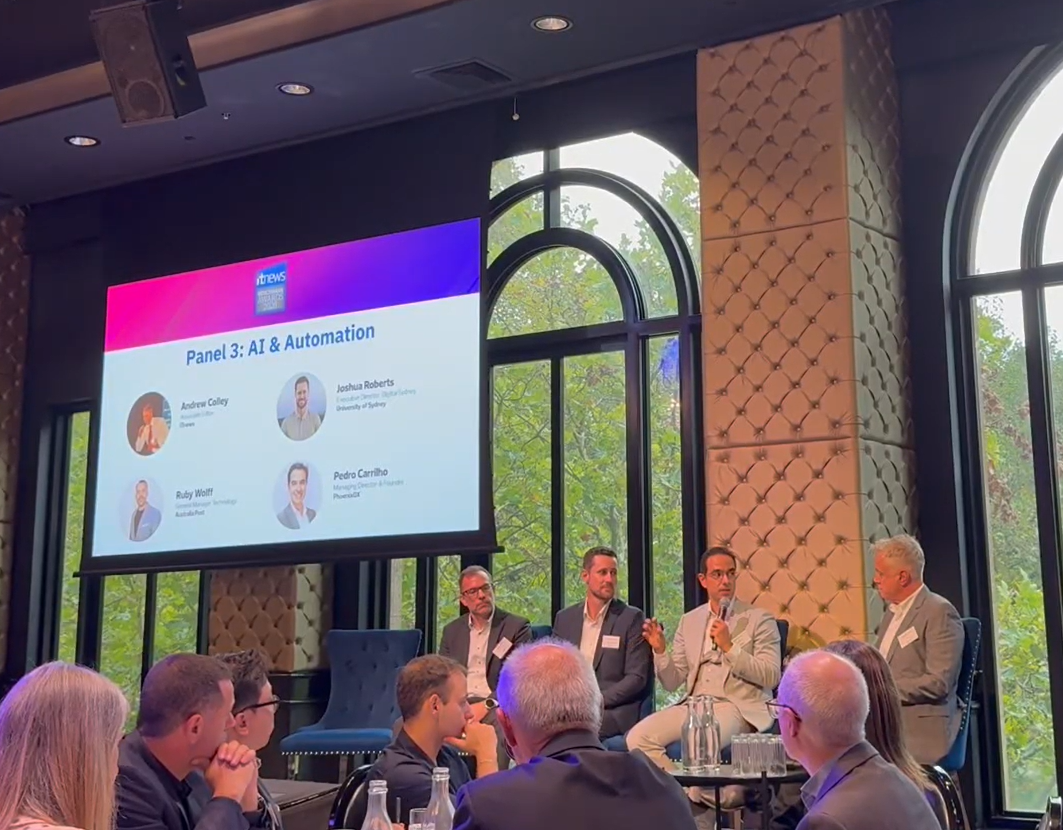
PhoenixDX Founder and Managing Director Pedro Carrilho took to the stage last Thursday night at the iTnews Benchmark Awards, joining an expert panel on AI and automation, with PhoenixDX also proudly sponsoring the event.
Drawing on more than two decades in technology, he highlighted how the role of AI in enterprise has rapidly shifted, from accelerating development to fundamentally transforming how systems are built, modernised, and operated.
The legacy challenge holding enterprises back
A key theme was the challenge enterprises face in moving legacy systems to an AI-first future. Many organisations, he noted, struggle with the complexity and scale of existing environments, often lacking visibility into what those systems actually do.
He shared a real-world example of a large enterprise system with over two million lines of code, in which PhoenixDX applied AI-first principles to reverse-engineer the application, achieving more than an 80% reduction in time and cost compared to traditional approaches.
“The biggest challenge is that people don’t know what they don’t know,” he said, pointing to the rapid pace of AI innovation and the difficulty for organisations to keep up.
Building AI capability from within
To address this, Carrilho emphasised the importance of building internal capability through “AI champions” and establishing centres of excellence to drive innovation in a controlled, scalable way.
Beyond technology, the discussion focused on the broader organisational shift required. Success with AI, he explained, starts with people: embedding AI skills across the business, not just within IT, and rethinking traditional models of scale.
“It’s no longer about armies of people. It’s about how you amplify skills through the right human-to-agent ratio,” he said.
Governance, cost and control still matter
Carrilho also highlighted the importance of governance, cost predictability, and data sovereignty – particularly for regulated industries – urging organisations to define clear business outcomes and guardrails before scaling AI initiatives.
Real AI gains are possible NOW!
While acknowledging the noise and uncertainty in the market, he was clear on what’s already real: significant productivity gains across the software development lifecycle, faster modernisation of legacy systems, and the growing use of AI agents in production environments.
“AI has moved beyond experimentation,” he said. “It’s now about applying it in ways that deliver real outcomes.”
