

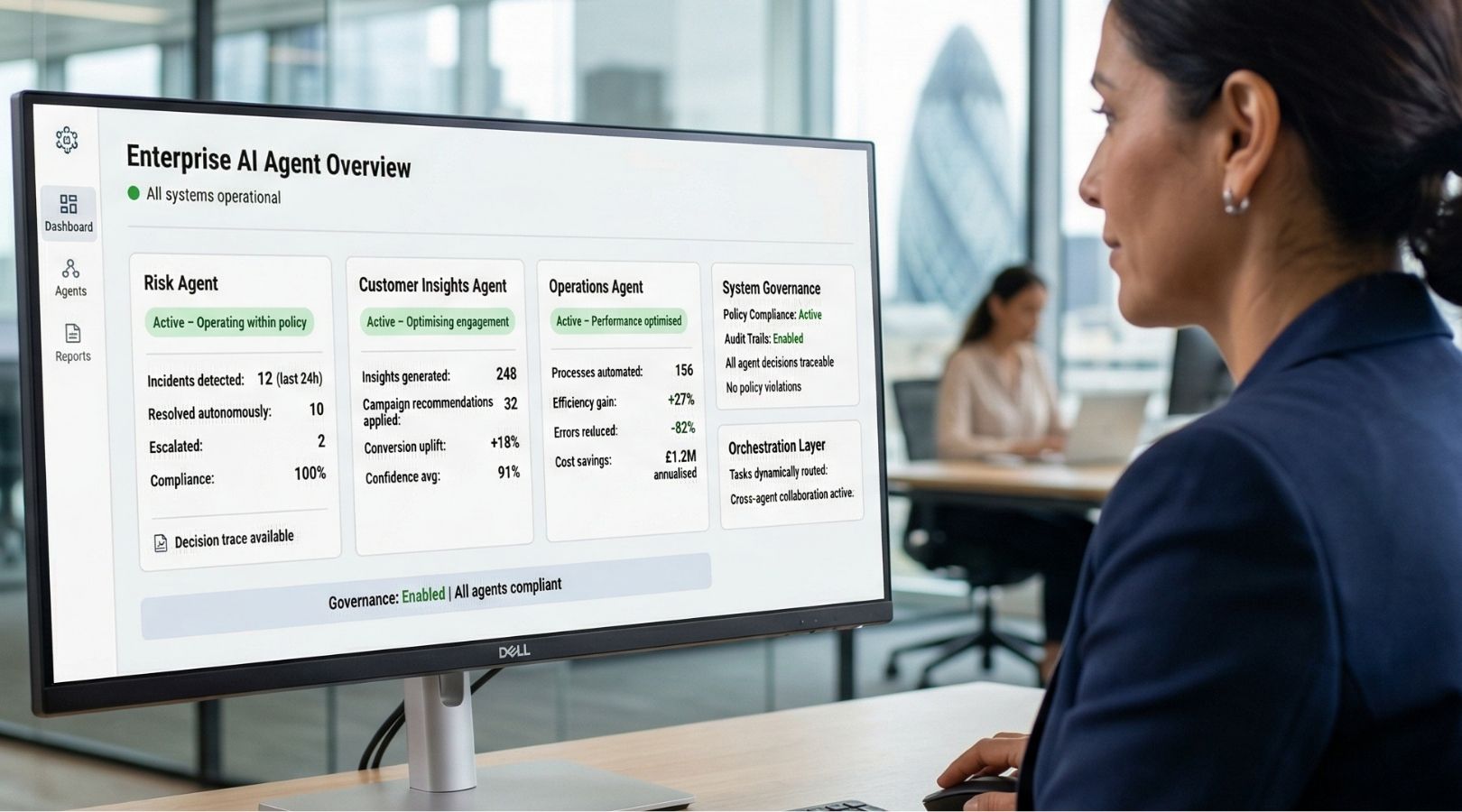
While many organisations are actively experimenting with AI agents, with 77% planning to invest in them this year, far fewer are successfully scaling beyond early pilots. The issue is rarely about technical capability. Instead, the real challenge lies in governance, risk management, and alignment with meaningful business outcomes.
Additional complexity
AI agents introduce a new layer of complexity into any enterprise. As agentic AI systems evolve, organisations rarely rely on a single model or provider. Instead, they operate within a diverse ecosystem of large language models (LLMs), each with different strengths, cost structures, and performance characteristics. While this flexibility can drive better outcomes, it also introduces significant complexity. Without proper controls, agent interactions can quickly lead to unpredictable and escalating expenses. And relying too heavily on a single provider can limit flexibility, increase risk, and reduce negotiating power over time. Without strong governance, that complexity quickly becomes unmanageable. Gartner predicts that by 2028, 40% of Fortune 1000 companies will experience a loss of control, with AI agents acting outside constraints or pursuing misaligned goals as their primary concern.
The governance gap
Many organisations are discovering that their current approach to agentic AI – relying on fragmented tools, isolated pilots, and manual oversight – simply doesn’t scale. What starts as a promising proof of concept becomes difficult to operationalise. According to Adapt, half of AI pilots lack formal governance frameworks, and 62% of data leaders report minimal data controls. Concerns around security, compliance, auditability, and model control begin to outweigh the perceived benefits. As a result, CFOs increasingly rank risk and compliance as the primary factors in allocating AI budgets.
This is why so many agentic AI initiatives stall. The issue is not capability, but trust, or more precisely, the absence of it.
Trust as the foundation for scale
When organisations trust their AI systems, they move faster. They deploy AI agents more confidently. They expand use cases across the business. Governance, in this context, is not a constraint – it’s an enabler.
Strong governance frameworks build trust in agent decisions and outputs, making stakeholders more confident in deploying them in real workflows. They enable organisations to scale safely by enforcing guardrails, defining acceptable behaviours, and ensuring accountability. They also support compliance by making agent actions transparent, traceable, and auditable.
The most effective organisations embed governance directly into their agent platforms, rather than attempting to retrofit it later.
The journey from first use case to AI factory
For most organisations, the path to agentic AI begins with a single use case. It is often narrow in scope, designed to prove value quickly, and typically built in isolation. While this approach is effective for learning, it rarely scales.
The challenge lies in moving from this initial success to a structured, repeatable model. This is where the concept of the AI Factory becomes critical. Rather than treating each agent as a standalone initiative, OutSystems AI Factory approach standardises the design, deployment, and governance of agents across the enterprise.
In an agentic context, this means creating reusable components such as orchestration layers, prompt frameworks, evaluation pipelines, and governance controls that can be applied consistently across use cases. It also involves defining clear lifecycle processes, from ideation and prioritisation through to deployment, monitoring, and continuous improvement.
Equally important is the integration of human oversight and accountability. As agents take on more autonomous roles, organisations must ensure that escalation paths, approval mechanisms, and performance monitoring are built into every stage of the lifecycle.
The AI Factory model also addresses much of the complexity inherent in agentic AI. It enables organisations to manage multiple LLMs, dynamically routing tasks to the right model for each use case while maintaining consistent outputs and behaviour. It allows proper controls to ensure agent interactions are monitored and optimised, and usage policies balance performance with cost efficiency. Furthermore, this approach allows businesses to avoid vendor lock-in. They are free to adopt abstraction layers that decouple applications from underlying models, allowing them to switch providers or incorporate new models as the ecosystem evolves.
A new way of working
The transition to an AI Factory approach is not just a technical shift. It is an operating model change. It requires alignment between business and technology teams, clear ownership of outcomes, and a disciplined approach to prioritising use cases based on value and risk. Organisations that make this shift can move beyond experimentation to build a well-governed, scalable foundation for agentic AI.
How it works in practice
Axos Bank recently implemented an agentic AI strategy using the OutSystems enterprise platform, introducing AI agents within a controlled, governed framework that ensures visibility, traceability, and oversight.
A key use case is an intelligent log analysis agent that interprets error logs, identifies root causes, and provides actionable recommendations. Its outputs are transparent and traceable, enabling validation and accountability. The bank has since introduced more agents, including one for document mapping.
With OutSystems, agentic AI governance is embedded by design, with clear data visibility, output auditability, controlled execution, and alignment with risk and regulatory frameworks. This ensures agents operate safely and securely in production environments.
“By creating and embedding agents into our operations, we are building a more intelligent and responsive banking ecosystem that is ready for the future of finance.”
Kevin Hear, SVP, Head of Consumer Bank Development, Axos Bank
The secret to Agentic AI success
Success with agentic AI is not defined by how quickly an organisation starts. It is defined by how effectively it can scale what works.
Organisations that build trust, align agent initiatives with business strategy, and embed governance from the outset through a platform approach are the ones most likely to turn agentic AI into a lasting competitive advantage.
