
Based on insights from more than 900 local IT and business leaders, ADAPT has introduced a horizon-based framework to help executives prioritise investment and reduce execution risk over the next three years.
What’s becoming increasingly clear is that moving through these horizons successfully isn’t just about choosing the right technologies. It’s about how those technologies are brought together. A fragmented approach slows progress. A platform approach accelerates it.
The state of the market: a reality check
The 2026 outlook highlights clear gaps in organisational AI readiness – gaps that must be addressed to avoid costly missteps.
Around 76% of organisations lack the data readiness required for AI, while 41% of mission-critical systems still sit on legacy platforms. At the same time, 25% of enterprises are repatriating workloads from the cloud, signalling a renewed focus on cost control and operational discipline.
Taken together, these trends point to a broader truth: the limiting factor is no longer access to technology. It’s the underlying foundations that allow it to be used effectively.
The 3 technology value horizons
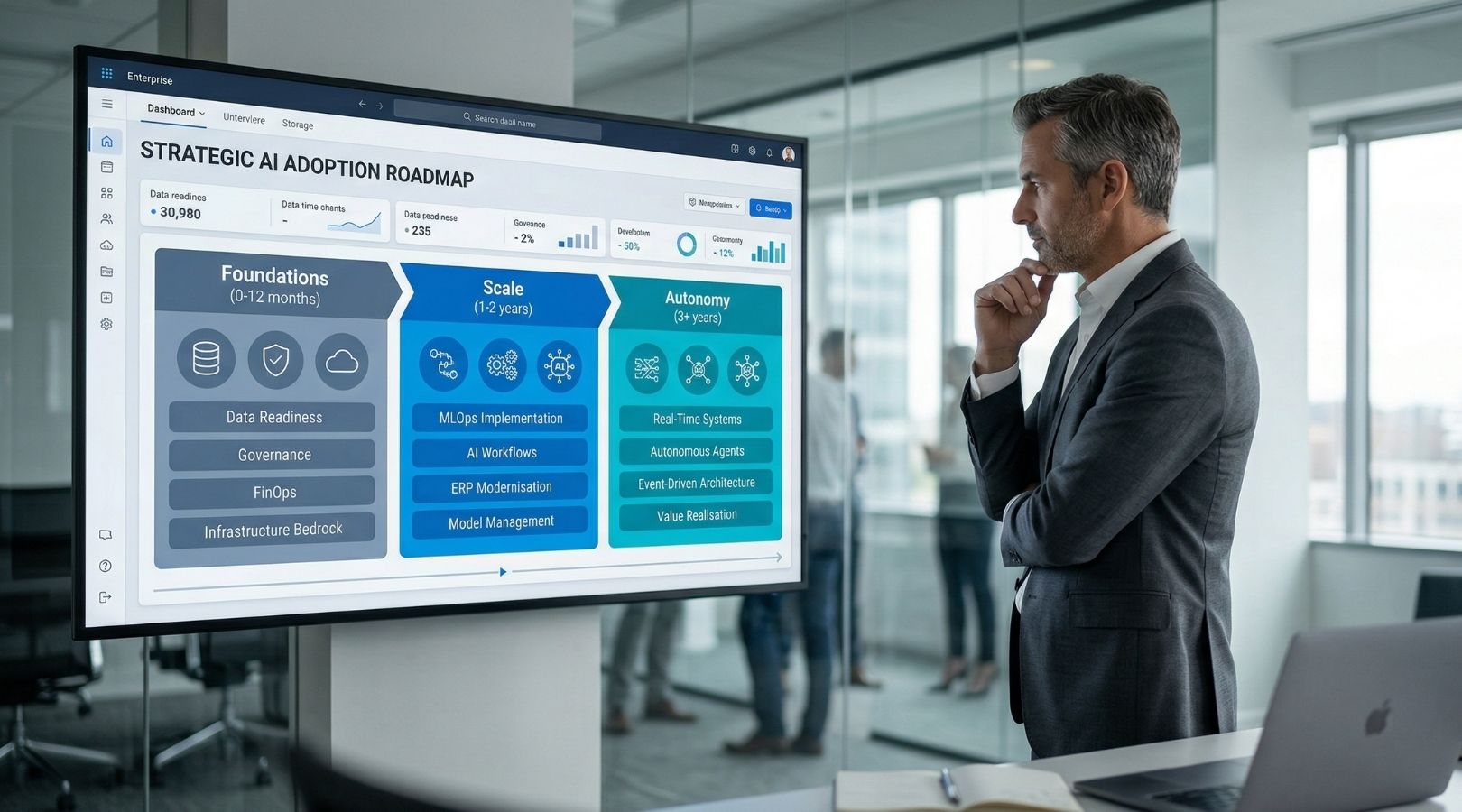
ADAPT’s model groups emerging technologies into three horizons, based on their maturity and the level of operational complexity required to deliver value.
Horizon 1: Foundations (0–12 months)
The first horizon is about getting the basics right: stabilising core platforms, reducing downside risk, and protecting early AI investments.
Key focus areas include secure enterprise LLM sandboxes with RAG capabilities, strong data quality and governance foundations, improved cloud cost management through FinOps, and the introduction of AI security guardrails.
Success at this stage is measured by meaningful adoption and control. Organisations should ensure that all generative AI activity is routed through approved, secure environments.
This is why leading organisations are rethinking how they invest. Rather than spreading budgets thinly across disconnected AI tools and initiatives, the recommendation is to front-load 60–65% of technology investment into foundational capabilities within the next 12 months.
A platform approach plays a critical role here, establishing a single, governed environment for AI usage, data access, and development, accelerating adoption while maintaining control from day one.
Horizon 2: Scale (1–2 years)
With strong foundations in place, organisations can begin to scale by embedding AI into workflows and modernising core systems to drive efficiency and business impact.
This phase introduces capabilities such as MLOps and AI evaluation platforms to monitor model performance, agentic AI orchestration platforms to coordinate multi-step tasks, and AI-enabled ERP modernisation to improve the performance of core systems.
Success here is defined by operational stability and measurable outcomes. Organisations can expect to see significant reductions in manual effort and cycle times, alongside more reliable and automated model deployment. Modernised ERP environments also deliver faster upgrades and improved efficiency.
This is where the value of a platform becomes even more pronounced. Scaling AI across the enterprise requires consistency, reuse, and orchestration. A platform approach enables organisations to standardise how models are deployed, how agents interact, and how workflows are automated, avoiding the fragmentation that often comes with point solutions.
Horizon 3: Selective Autonomy (3+ years)
The final horizon focuses on more advanced, future-state capabilities: real-time architectures and autonomous systems that depend on the foundations laid in earlier stages. This includes technologies such as real-time data fabrics (event meshes) that enable seamless, event-driven data flows across systems, and next-generation infrastructure, such as liquid-cooled data centres designed to support high-density AI workloads.
Success at this stage is measured by agility and scale: faster time-to-insight, greater real-time capabilities, and more efficient, high-performance infrastructure.
Reaching this level of autonomy is only possible when organisations have already established a strong, integrated foundation. A platform approach ensures that as systems become more autonomous, they remain governed, observable, and aligned, rather than becoming increasingly complex and difficult to control.
The bottom line
The message from ADAPT is clear: success in 2026 and beyond will not come from experimentation alone. Organisations that try to leap ahead without investing in foundations risk fragmentation, rising costs, and stalled initiatives. Those that take a more disciplined approach, prioritising data, governance, and cost control, will be better positioned to scale AI with confidence.
And increasingly, that discipline is enabled by a platform approach: one that connects strategy to execution, and innovation to control. Because the future isn’t just about adopting new technology. It’s about building the right foundation and the right platform to make it work at scale.
