- Home
- DX insights
- Why, in 2026, is it still so hard to digitalise your business?
Why, in 2026, is it still so hard to digitalise your business?
The statistics around the progress of digital transformation are confronting for any business leader. Major strategy and consultancy firms such as McKinsey, BCG, and Bain rate the risk of failure for a transformation program at 70%-95%, while ADAPT reports that 73% of Australian companies are weighed down by technology debt. So why are many organisations still finding it hard to achieve tangible results from their digital transformation strategy?
A clue lies in the fact that most companies today run core systems introduced decades ago, designed to meet their business needs at that time. To keep up with changing business needs and market trends, many organisations have customised these core systems over the years to deliver additional functionality. This has led to an internal landscape of complex customisations, core systems that are difficult to update and, ultimately, a technology environment that can make it difficult for companies to keep up with new opportunities in their digital transformation roadmap.
The ‘jar of life’
We like to use the ‘jar of life’ analogy to explain how organisations can move past this situation and leverage the benefits of a digital transformation strategy that meets their business needs while supporting crucial innovation. In this timeless story, ‘the jar of life’ represents the time and resources you have available to live your life. To best fill the jar, you place the most important things – the ‘big rocks’ – inside the jar first. Next, you add the ‘pebbles’ – the smaller things in life that still matter and can fit in between the ‘big rocks’. If you only add ‘big rocks’ to the jar and nothing else, your life will never be as complete as it could be – there will always be gaps in your potential. Crafting and adding the ‘pebbles’ around the big rocks is the key to filling all the empty spaces in your jar and is the secret to a complete and satisfying life.
How does the ‘jar of life’ story apply to an IT ecosystem?
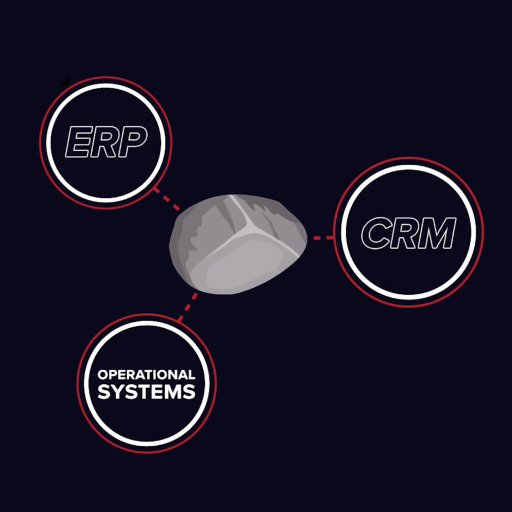
For a company to reach digital transformation – to fill its ‘jar’ – it must continually deliver its ‘rocks’ and ‘pebbles’ in the best possible way. The goal is to create an IT ecosystem that meets business requirements and is flexible and scalable enough to adapt to new technologies and changing business needs. Nowadays, most enterprise-grade organisations handle their primary business functions using ERP, CRM, ITSM, HRIS and CMS systems – the ‘big rocks’ in their jar. Companies pursue various approaches to deliver the ‘pebbles’ in their jar – other medium-to-small digital solutions vital to their business. These approaches include:
- Customising their ‘big rocks’, which is understandable as an initial strategy. Often, companies have made a substantial outlay for these systems and are trying to maximise the return on their investment. Further, core system vendors encourage their clients to use the vendor’s customisation tools to develop new capabilities and build solutions that are often outside the specialty area of that vendor’s system.
- Purchasing various (often departmental) off-the-shelf products that solve specific problems but can’t integrate with the enterprise systems.
- Building software from scratch using programming languages (e.g. mobile apps) and integrating them back into the ‘big rocks’ directly or through middleware. Hand coding has become incredibly complex, slow and expensive.
- Automating the repetitive parts of a process using robotic process automation (RPA) tools. This works well for automating simple manual tasks but not for human-centric workflows.
Unfortunately, most organisations still have a plethora of broken processes, with a mix of digital and manual steps (e.g., spreadsheets, PDFs, email, phone). In some cases, the cost of digitalising these processes using the above approaches can’t be justified, so they stay the same. Organisations that rely solely on ‘big rocks’ struggle to accelerate digital transformation.
5 challenges when organisations use ‘big rocks’ to do ‘pebbles’ work
1. ‘Big rocks’ are hard to customise, even using the vendor’s own development tools. Some well-known SaaS vendors provide no-code and low-code capabilities for customisation within their environments. In reality, these limited tools can only take you so far before you must employ proprietary high-code to meet the functionality requirements. Excessive package customisations usually contribute to the pain and cost of core system upgrades every 3-5 years.
2. Each ‘big rock’ introduces its own languages and toolsets, requiring a multitude of skill sets, which are costly and complex to manage. No-code, low-code, JavaScript, APEX, ABAP, Eclipse, and Spartacus are just a few examples of the software development toolkits offered by the largest packages on the market. Often, these languages and toolsets are proprietary, which makes it expensive for companies to keep their customised systems evolving. Further, IT leaders are left with the headache of finding and retaining a highly qualified army of professionals within their teams and/or managing a multitude of vendors.
3. End-to-end digital processes cut across ‘big rocks’. Today’s business requirements include delivering unified customer and employee user experiences and end-to-end digital processes that require integrations and synchronisations across multiple core systems. Most companies struggle to determine which core system to extend to achieve the desired results. This approach can blow out your budget with licenses if the new processes involve many users.
4. ‘Big rocks’ lead to fragmented UI: When companies have multiple core systems, they end up with multiple types of user interfaces, creating fragmented experiences across (and sometimes within) their ecosystems, both for their customers and employees. Customers end up with multiple sign-ons to manage their accounts or services, which is frustrating. Employees must log in to many systems and perform double-handling tasks to complete their jobs. Improving and integrating the UI of each different system is unmanageable and doesn’t create the smoother user experiences needed to increase user satisfaction, operational efficiency and uptake of digital offerings.
5. ‘Big rocks’ don’t offer great UX: There’s no avoiding the fact that the UI tools that come with core systems are typically limited. Without a lot of coding, they simply aren’t capable of achieving pixel-perfect UI on any device – web, mobile or PWA – which are must-haves to compete effectively in today’s B2B or B2C spaces.
GPT Group uses a separate platform for 'the pebbles'
A leading property company, GPT was committed to a best-of-breed technology architecture strategy and relied on various core systems, such as SAP and Salesforce, to handle their primary business functions. However, they ran into issues when they needed to develop end-to-end experience-centred solutions for their employees that had to cut across their various systems.
GPT had initially built an application to streamline their procure-to-pay process by customising one of their ‘big rocks’ using SAP Screen Personas. Despite their best efforts, the application was clunky and had performance issues, with the software version soon to be unsupported. The application would only work on Internet Explorer and required a VPN to access remotely. GPT had to replace the application, but instead of rebuilding it using SAP’s new tool, they decided to adopt a different approach.
The company came across the OutSystems platform after looking for the best-of-breed platforms in the market. They were impressed by how quickly the platform would enable them to build applications that could complement and extend their existing core systems, simplifying and accelerating their digital transformation. They found the OutSystems platform was the ideal tool for creating the ‘pebbles’ that could fit in and around the ‘big rocks’ in their ecosystem to deliver the end-to-end employee experiences they needed.
By working with PhoenixDX and OutSystems, GPT initially created a CAPEX approval application in only 8 weeks. The new app interacted with their budgeting/forecasting system, document management system and SAP. This project gave them the confidence to use OutSystems to rebuild a more extensive procure-to-pay application, providing an intuitive user interface on top of their SAP, at a fraction of the cost it would have taken to build it using SAP tools or hand-coding.
The new application transformed their employee experience,
resulting in a 60% increase in productivity.
GPT now relies on the OutSystems platform as its centrepiece for delivering front-end digital projects for customers, employees, suppliers and tenants. They have built several applications using OutSystems since then.
Leave your ‘big rocks’ for what they do best
Businesses need a platform specifically designed to deliver applications for a wide range of use cases and pixel-perfect interfaces that seamlessly integrate with any core system. Named a leader in Gartner’s Magic Quadrant for many consecutive years, OutSystems can help your business fill your digital transformation jar in a fraction of the time and at a fraction of the cost of traditional approaches, leaving your ‘big rocks’ to do what they do best.
Share on LinkedIn